Your first AI task is probably already on your calendar.
You don't need a new software stack. Pick one repeatable job, give the tool good input, and measure whether it actually makes your week easier.
 By Dani Furmenek · Pretty Smart Prompts
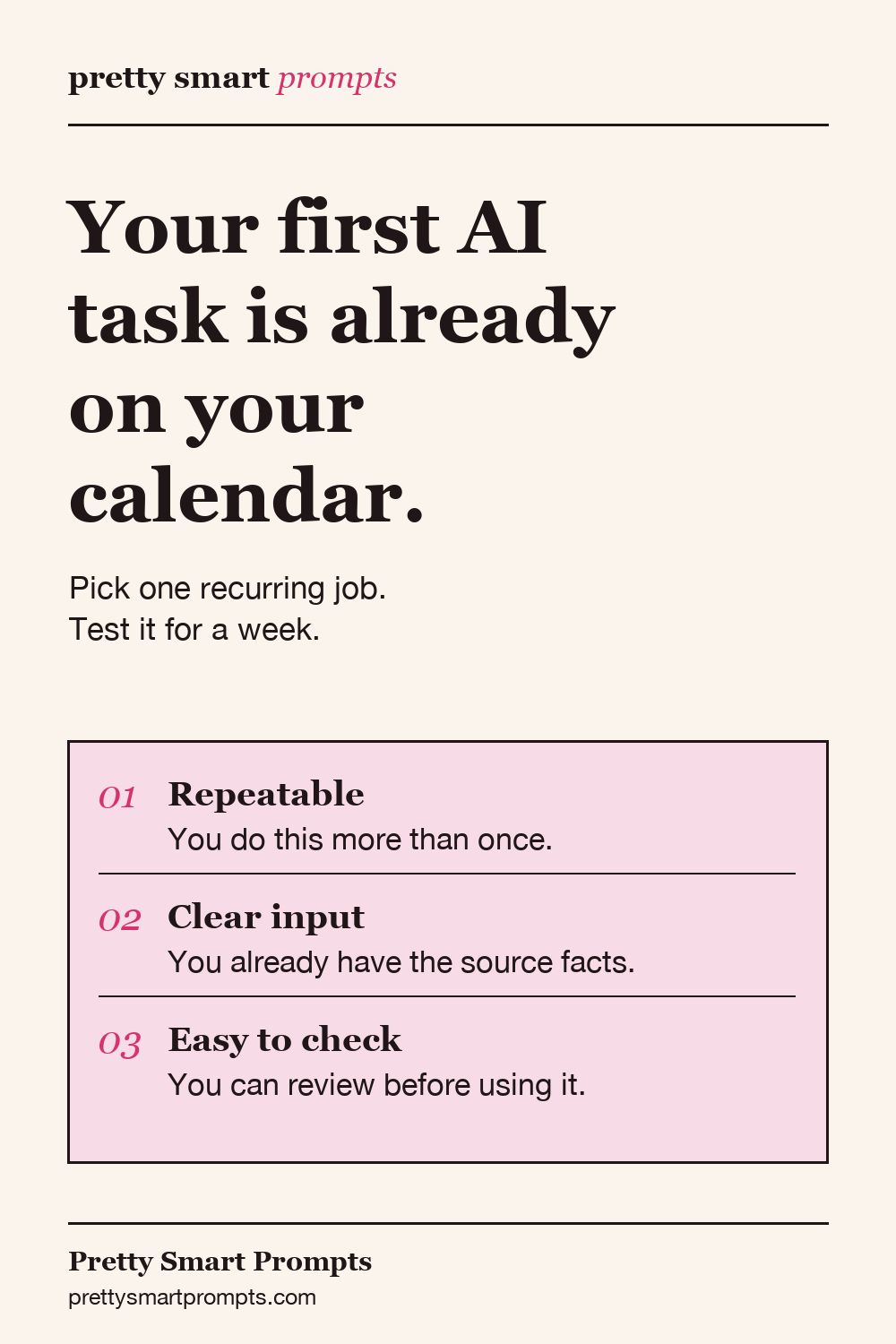
Find a small, repeatable job.
Look at the work you did three or more times recently. A task is a good first test when you can explain what goes in, what a good output looks like, and how you will check it.
- 01Write down three recurring tasks.
Examples: first replies to inquiries, meeting summaries, or turning call notes into a follow-up email.
- 02Pick the one with clear inputs.
You should already have the email, notes, or source material. Don't start with a task that needs the tool to invent missing facts.
- 03Keep the stakes manageable.
You can review a draft reply before sending it. Don't let a model set prices, make legal commitments, or decide who gets hired.
- 04Time the whole job.
Include writing the prompt, correcting the draft, and checking the result. If that total isn't lower, the tool hasn't saved you time yet.
Here is a sensible first test.
Illustrative example: a solo service provider gets similar inquiry emails each week and wants a faster first reply.
Task · draft a first inquiry reply
Input: The inquiry email, the service description, the current booking link, and two replies the owner previously sent.
Output: A short reply that answers the question, says what happens next, and includes the right link.
Owner check: Confirm availability, price, link, and tone before sending. If those facts are missing, the draft should say [CHECK].
The tool helps with the first draft. The owner still owns the promise and the send button. If the inquiries are all different, a saved reply template might beat AI.
Try one task in the tool you already have.
Use your own facts and remove private customer details you don't need to share with the tool.
Copyable prompt
I run a one-person [type of business]. I want help with this recurring task: [describe the task].

Here is the source material I already have: [paste only the relevant facts and remove unnecessary personal details].
Here is what a good result must include: [list the requirements].
Here are two examples of how I have done it before: [paste your examples].

First, tell me what information is missing. Do not guess missing facts. Then draft one result I can review. Mark any uncertain detail as [CHECK]. After the draft, give me a short checklist of what I must verify before using it.
For a new type of job, ask for one draft. Do not build a complicated automation until the manual version proves useful.
Run a one-week test.
A useful tool should reduce the work you actually feel, not just produce more text.
- Baseline: Time one normal version of the task without AI.
- Trial: Use the same prompt on three real instances, reviewing each result.
- Record: Note total minutes, number of corrections, and whether the output was good enough to use.
- Decision: Keep it if it reliably saves time and the review burden feels reasonable. Otherwise improve the input, use a template, or move to another task.
The test is how you find out whether a task actually saves you time.
Get the four routines I use for client work.
A free nine-page guide plus templates for research, AI briefs, billable hours, and final review.