Make AI writing sound like your business.
The fix is more specific than “write in my voice.” Give the tool an example, the facts it can use, and a job for this draft. Then make the final edit yourself.
 By Dani Furmenek · Pretty Smart Prompts
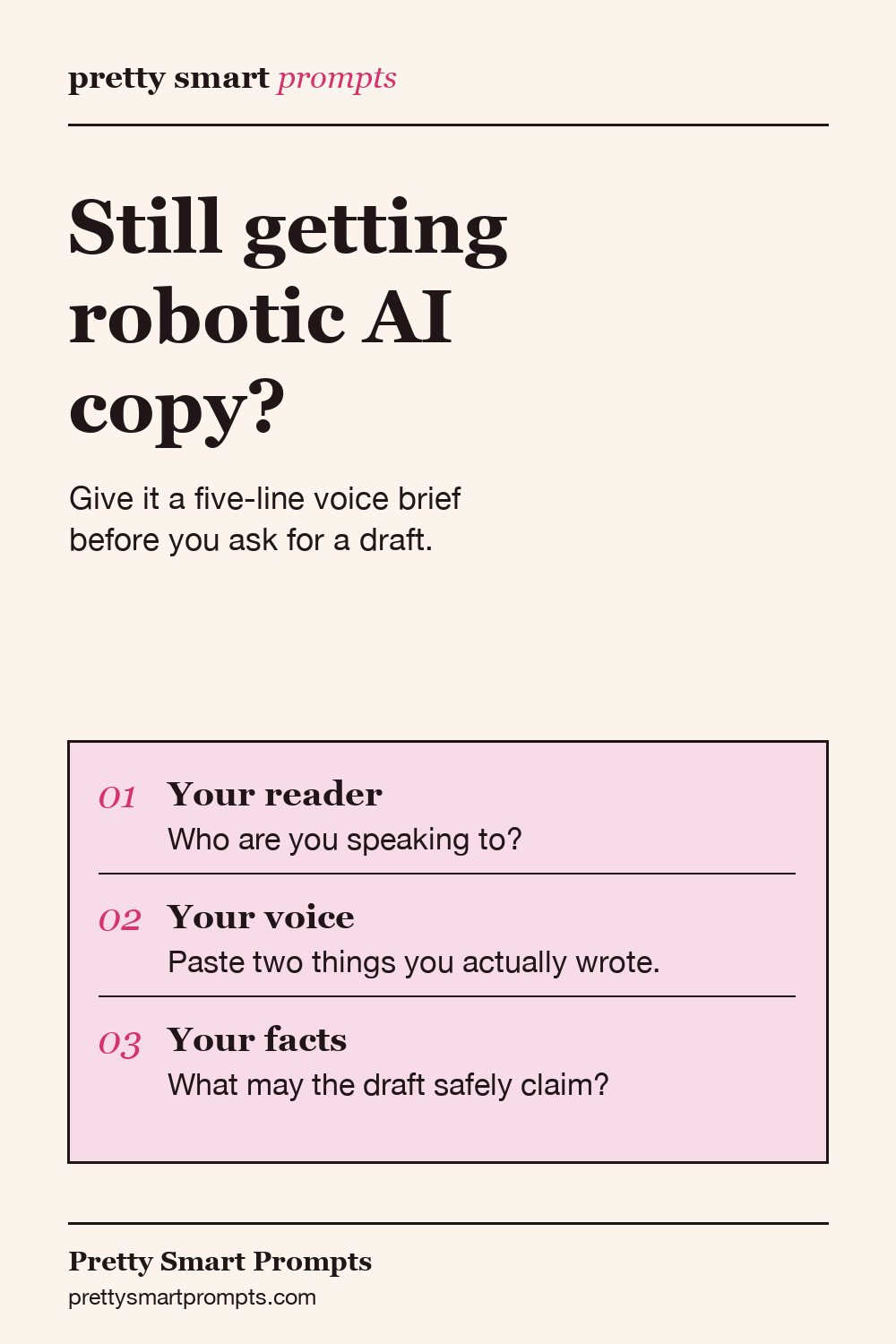
Write a five-line voice brief.
Keep it in a note you can paste into any writing tool. Use sentences you'd actually say, not a list of brand adjectives.
- 01Who you help.
“I help [specific person] with [specific job].”
- 02What you believe.
“My take on this is [opinion you can defend].”
- 03What you sound like.
Paste two short paragraphs you have written, ideally on the same subject.
- 04What you avoid.
Name the phrases, promises, or tone that don't belong to you.
- 05What is true today.
Add your current offer, policy, and any details the draft is allowed to mention.
See the edit, not just the instruction.
This is an illustrative home organizer example. It's a writing exercise, not a client result or a quote from my work.
Generic first draft
“Transform your home into a beautifully organized sanctuary. Our personalized solutions will help you reclaim your space and simplify your life. Book your journey today!”
Edited for a specific customer question
“You don't need to clean before I arrive. Leave the closet the way you use it, and we’ll start by figuring out what needs to fit. If there’s anything private, set it aside first. Then tell me which part of the space slows you down most.”
The edit removes the generic promise, answers the real objection, and gives one clear next step. It also assumes this organizer’s actual policy is to see the space as it is. Change the policy before using this example for your business.
Give the tool a boundary.
The prompt below asks for a draft and a change log. The change log makes it easier to spot where the tool added something you did not say.
Copyable prompt
I run [type of one-person business] for [specific audience]. I need a [email / page section / caption] that helps the reader [specific task].

My voice examples: [paste two short things you wrote].
My point of view: [one specific belief].
Facts this draft may use: [paste verified offer, process, price, timing, or policy].
Words or claims to avoid: [your list].
The reader's question or situation: [paste it].

Write one draft in plain language. Keep it under [word count]. Answer the question before describing my business. Do not invent proof, testimonials, urgency, prices, results, or policies. Mark any missing fact as [CHECK].

Then give me a short change log: which facts you used, which voice examples shaped the draft, and what still needs my review.
If the output sounds polished but vague, ask it to name the customer’s exact next step. If it can't do that from your source material, add more source material before you touch the tone.
Keep the final edit human.
A good voice brief speeds up the first draft. It doesn't hand over responsibility for what you promise.
- Read it aloud. Would you say this to a customer on a call?
- Check every promise. Is the price, timing, result, or policy actually yours?
- Keep the useful sentence. If a paragraph says nothing specific, cut it.
- Choose the next step. Make it clear what the reader can do after reading.
Save the edited version as your next voice example. Over time, the brief becomes a record of what you really publish.
Get the four routines I use for client work.
A free nine-page guide plus templates for research, AI briefs, billable hours, and final review.